In the wake of the Brexit referendum in 2016, I became interested in initiatives that could help to reduce negative attitudes to migration in the UK. The idea for the Migrateful cookery classes came about following conversations with refugee and migrant women at a skill exchange program I was running in East London back in September 2016. They all said they’d like to teach their community to cook. I was taken by this idea not only because I saw the potential for it to offer employment for these women but also because I had a feeling that bringing migrants and the British public together to bond over food could help reduce negative attitudes toward migration. What I didn’t realise at that point was that there is a whole body of research to support why this kind of initiative works so well to shift negative attitudes; it’s called “contact theory”.
Independent research into Migrateful’s model, conducted by Reema Patel in 2022 and designed with input from Professor Keon West, an expert in contact theory at Goldsmiths, University of London, found that the Migrateful model works very well in meeting all the conditions required for a successful “contact” intervention. This research has been published on the Migrateful website for the first time today. The report’s findings are really exciting because they validate my initial hope that the Migrateful model not only helps migrants and refugees to integrate and access employment but also works to shift negative attitudes to migration amongst the general public.
What is contact theory?
Contact theory, developed by Gordon Allport in 1954, states that if two groups interact in a setting with equal status and a shared goal, it can reduce prejudice towards the minority/outgroup. The effectiveness of contact theory is well-established in the academic literature. According to a meta-analysis of 713 samples from 515 studies, intergroup contact was found to be very effective in reducing prejudice towards the outgroup. It was originally tested on racial minorities but has been shown to work for any outgroup experiencing prejudice. Contact does this by reducing fear of the outgroup, enabling information about the group to be effectively absorbed and in turn building empathy. The largest-ever public consultation on immigration in 2018, conducted by the think tank British Future found that social contact with migrants had a significant impact on how people viewed them. Negative views tend to dominate in places where migrants are less well-integrated into their local communities.
What does the research show?
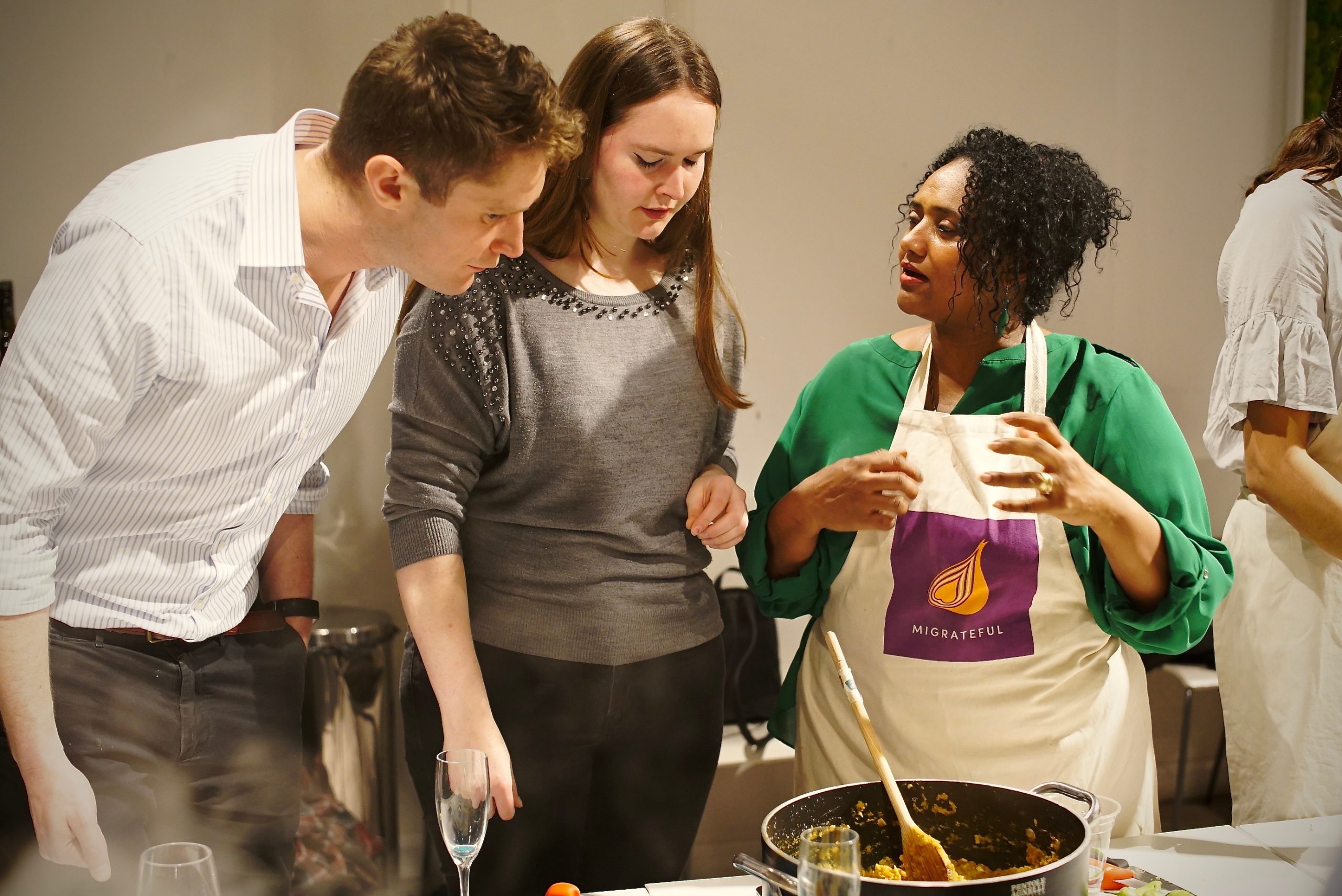
The independent research found that the Migrateful cookery class model worked very well in meeting all Allport’s conditions. It facilitates equal status between the migrant chef and participants, intergroup cooperation, and shared goals (preparing a meal). Interviews conducted pre- and post-cookery classes as part of the research found that the opportunity to have direct, personal contact with migrants has a deeply humanising effect, as explained by one participant:
“[The cookery class] gives you an opportunity to learn about people. Somebody who’s never met a refugee might just have this image in their heads of what it might be like and maybe it’s a negative image. Maybe they think there’s just a bad thing but when you get to know people, you can see the humanity behind. You know, that helps break down the stigma, negative thoughts, things like that.”
Class participant from 2022 research
How many people has Migrateful reached so far?
After each cookery class, participants are sent a post-class survey which has so far been filled out by 3800 participants. 45% of participants report increased knowledge about migrants’ situations and 33% report feeling warmer attitudes toward migrants after attending the class. 45,705 participants have attended the Migrateful classes since it was founded in 2017; using these percentages equates to over 20,000 people with increased knowledge about migration as a result of our classes and 15,000 people having warmer attitudes to migrants. According to Schmid et al.’s research (2021), the positive effects of contact can also spread to friends and family, therefore expanding further the numbers of those with warmer attitudes as a result of our classes.
Who is the model trying to reach?
It is likely that the group that the Migrateful classes are best suited to target is the “balancer middle”. The balancer middle makes up around 50% of the British public; they are not completely against migration but want fair rules which don’t let everyone in. They sit between the migration sceptics who are strongly against migration and the migration liberals who are pro-migration. After attending a Migrateful cookery class and experiencing positive contact with a migrant, the participant from the balancer middle is expected to feel less worried by the idea of a migrant coming to the UK and therefore less supportive of hostile policies towards migrants. The reason we suspect the Migrateful model is most effective with the balancer middle is because this group is open to negotiation on what a fair approach to migration consists of and is therefore more receptive to new positive information about migrants which dispels former misconceptions. The model may be less effective with migration sceptics who are less open to new information which challenges their anti-migration views.
We now know from the independent research that the classes naturally appeal to those from the balancer middle, reaching beyond those groups who are primarily interested in supporting migrants. The report shows that classes are often attended by those who wish simply to learn about new food, or who were gifted a class voucher by a friend or family member. Our corporate classes also bring in participants who have not chosen to attend themselves but are required to do so as part of a team-building event. The potential for attitude shift appears higher with corporate clients, as demonstrated in the larger numbers reporting a change in attitudes (31%) and knowledge (55%) after their class than those in our public classes.
Why food?
The polling data in the table below shows that British citizens tend to be fairly negative about the contribution of migrants to the country. However, the area they feel most positive about is food.
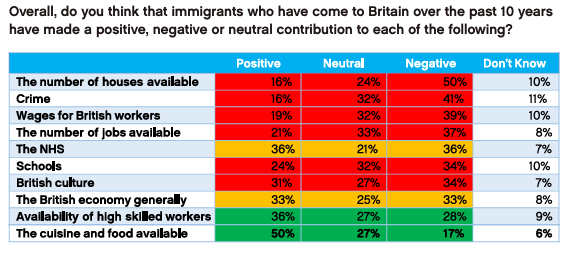
Migrateful’s cookery classes capitalise on these more positive sentiments towards migrants’ contribution to the country’s available food. The really powerful thing about food is that everyone in the world eats food and everyone loves food. It’s this very uniting thing that we have as humans and it’s very obvious in a place like London how much we appreciate food from around the world. For me, it was clear from the beginning that food was that way in to bring everyone together over a common passion; everyone is happy when they’re making and eating food together – it’s a very bonding experience!
What further research is needed now?
Going forward, we want to gather further data on both the durability of any attitude shifts and whether these shifts then lead to behavioural change. We want to understand our model’s effectiveness in different demographic groups and areas with stronger anti-migrant attitudes. We also want to ensure that the messaging during our cookery classes is optimised to ensure we are making the most of the model’s potential to catalyse change.
You can read the full research report Fostering Belonging here: