
“When I see the English flag being flown, it makes me feel unsafe,” my colleague, who migrated to the UK five years ago told me. This was echoed by others in our community from migrant backgrounds who had previously felt comfortable in the UK but were left questioning how welcome they were as English flags appeared on their streets in increasing numbers over the past year. Today is St George’s Day, England’s national day, commonly marked by the flying of the England flag, which features the Cross of St George. But for many people in England, the sight of that flag does not feel celebratory.

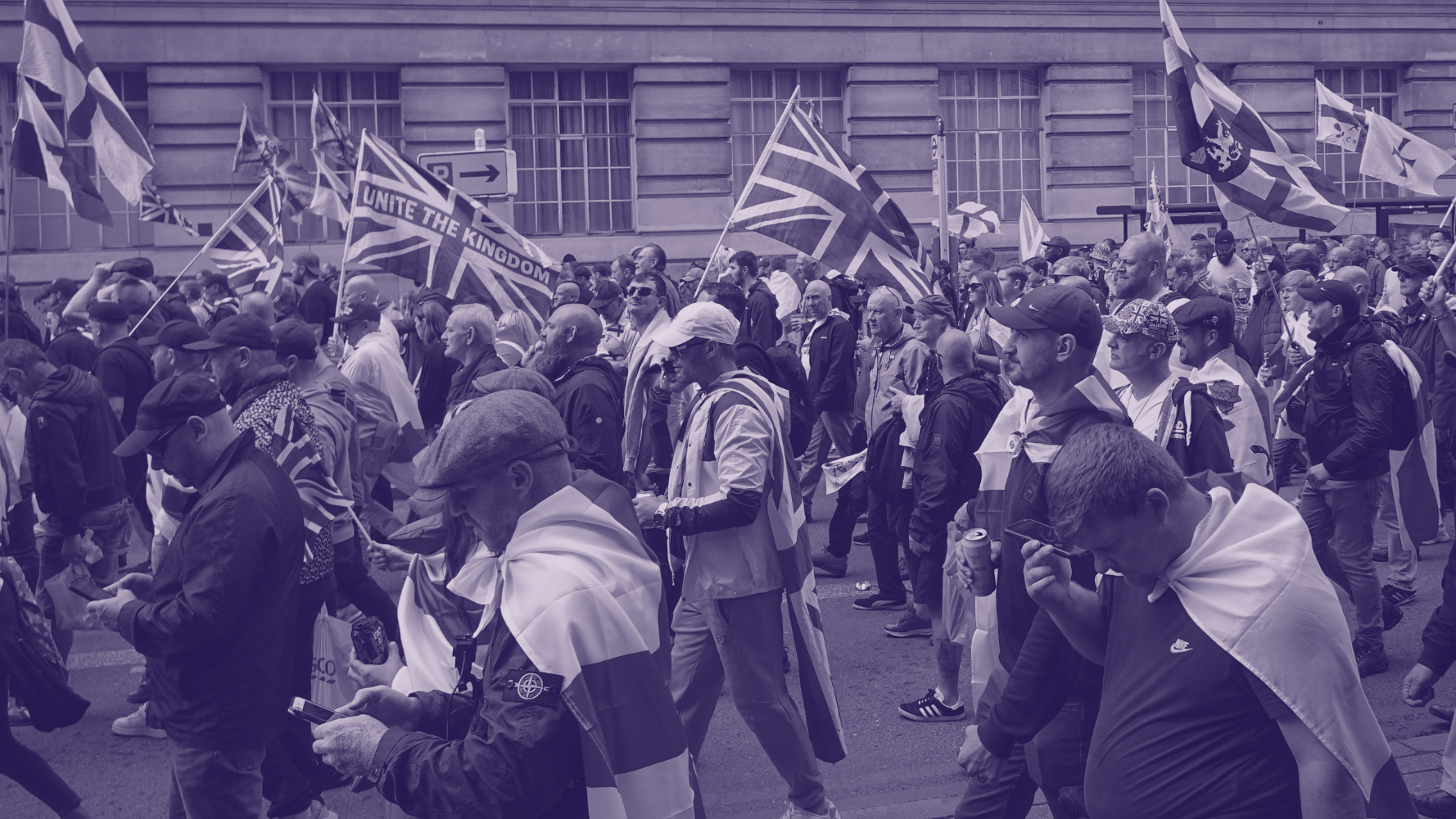
This is because the England flag has been used by far-right groups in recent history, often in explicitly racist ways intended to intimidate minority communities. In the 1970s and 1980s, the National Front displayed it during marches through areas with large Black and Asian populations, often accompanied by racist slogans and violence. In later decades, the English Defence League has used it in anti-immigration campaigns. More recently, initiatives such as Operation Raise the Colours, launched in August 2025, have encouraged the widespread display of flags on streets and lampposts. While framed by supporters as promoting patriotism, anti-racist groups such as Hope Not Hate have linked this activity to far-right organising, intended to inflame tensions. Although these racist views are held by a minority, the visibility of the flags can make them feel far more widespread.
A potential solution?
Seeing these flags go up, and feeling both their impact on our community and my own powerlessness to stop them, I was struck by British Future’s new toolkit which explores the idea that English identity has been neglected, allowing the far right to shape it in divisive ways. Caroline Lucas makes a similar case in her book Another England (2024), arguing that the far right has been more willing to articulate what Englishness means, while others have shied away from the conversation altogether – perhaps unsurprisingly given many people feel uncomfortable identifying with a national identity shaped by the history of empire. As a result, a narrow, exclusionary version of Englishness dominates the public conversation, shaping how people understand national identity and who is seen to belong.
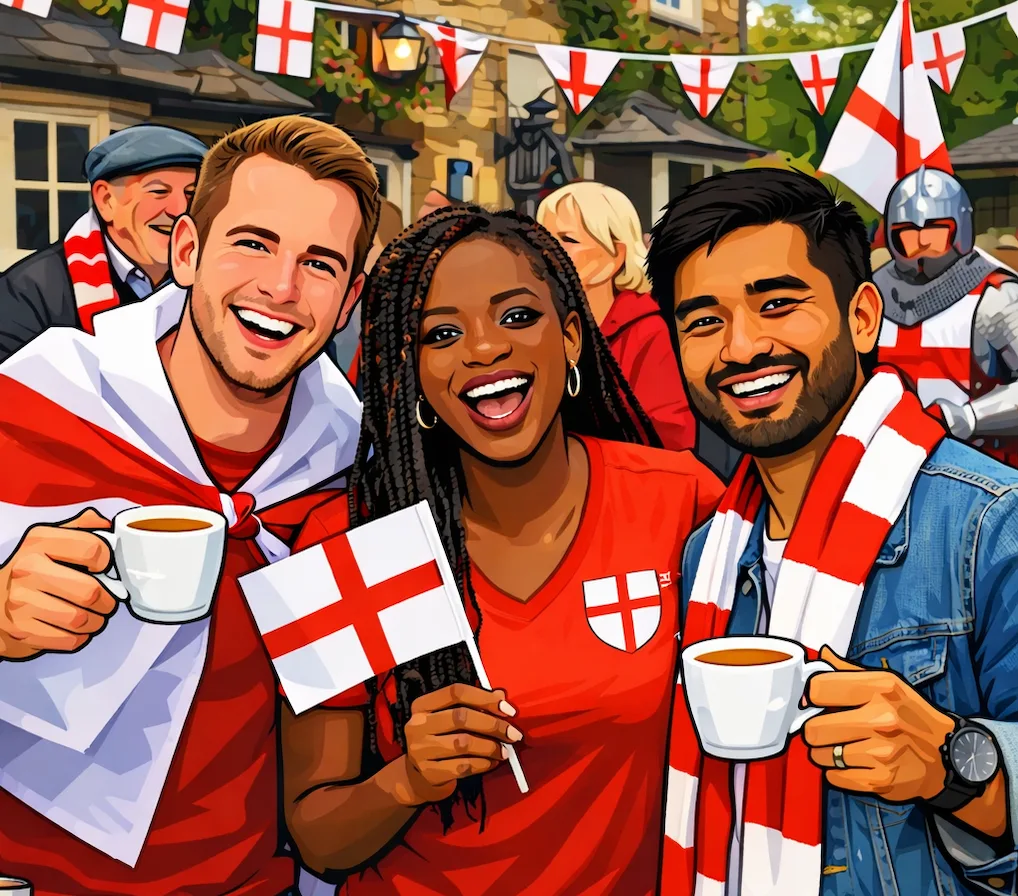
British Future’s toolkit calls on organisations and individuals to actively express an inclusive English identity in public life, through communications and events, such as St George’s Day, rather than leaving this space to more extreme voices. Their research suggests that the public is receptive, with 83% agreeing that Englishness is open to people of all backgrounds (p.6). The idea is that if civil society promotes an inclusive vision of Englishness, it becomes harder for far-right groups to dominate that space, reducing their influence and, over time, reshaping the meaning of symbols like the flag.
When I suggested a Migrateful St George’s Day event to one of our chefs from Trinidad and Tobago, she said: “Yes, I’d come to an event that celebrates Englishness. I’m proud to call England my home and I’d like to celebrate this country. We shouldn’t be intimidated by what a minority group has used the flag for. The English people in my cookery classes have been so welcoming to me – I love English people.” It was starting to feel compelling. We could take a picture at our chef party, like the front cover of British Future’s toolkit (displayed here), and share it on our socials alongside a message from the document such as: “Englishness should be open to everyone who calls this country home, whatever their skin colour, faith or heritage.” (p.24). I was so taken by the idea that I ordered an England flag so we’d have it in time for our next chef social.
The challenge in practice
But it wasn’t long before I began to doubt the plan. My husband was sceptical when the flag was delivered in a see-through packet whilst our neighbour was putting out the bins. “Why did you order an England flag to our house? Our neighbours might think we’re racists!”
A friend said: “I think that is a really naive idea and you shouldn’t do it. The reality is that the far-right do own the flag. The Migrateful chefs might agree to come to a party celebrating Englishness and take a photo with the flag, but because they’re newly arrived to the country, they might not know the history of how the flag has been used as a symbol of violence against minority groups in the UK.”
She made a very good point. And whilst some of our chefs may not be familiar with the historical use of the flag, others will have had upsetting experiences with it. Recently, the flag has appeared at demonstrations outside asylum accommodation, so for some of our chefs who live in hotels, it is a symbol associated with hostility. After further discussion with my team, we agreed that even with the best intentions, a St George’s Day social media statement featuring the flag could be taken out of context, drawing Migrateful into polarised debates and potentially putting our community at risk if it were to provoke a reaction from far-right groups.
I also found myself wondering: does celebrating Englishness through symbols like the flag risk strengthening the nation-state system, a global power structure in which governments decide who is entitled to rights and who is not? This may sound abstract, but for our chefs it is not. Many spend years waiting to be granted rights by the UK government, barred from working or accessing benefits in the meantime. This reflects an idea in the work of Hannah Arendt (1968), who argued that human rights do not truly exist outside the nation-state system, because people must first have the “right to have rights” within it. The power of the state depends on people believing in the nation and identifying with it, so expressions of nationalism can reinforce this power.
Where does this leave us?
Does embracing Englishness have to mean strengthening the power of the English government? Perhaps what we are really talking about is something simpler: celebrating the place we live in and enabling everyone to feel a sense of belonging. If stepping forward to define a more inclusive vision of Englishness can help counter the influence of far-right groups, then it feels important to find ways of doing that in practice. While England is far from perfect, with deep-rooted inequalities that still need addressing, there is also much about this country to celebrate. Our Trinidadian chef’s words stay with me. She describes English people as kind and welcoming. That is what matters: people from different backgrounds live together peacefully across much of this country.

To counter far-right rhetoric that defines belonging in exclusionary terms, we do perhaps need to find a way to celebrate England for what it is: a mix of many different people who all belong here. This means focusing less on reclaiming a single symbol like the flag and more on shared points of connection that people from all backgrounds can feel proud of. For example, sport, like food, is a universal human passion that can unite us. We see this in the way the country rallies round the England national football team. Players like Bukayo Saka, Marcus Rashford and Marc Guehi have roots in Africa and the Caribbean, and others like Declan Rice, who has Irish family roots, reflect different parts of England’s story. When the team plays, people rally behind them not because they share the same origins, but because the team creates a shared sense of belonging – bringing together people who may have very different backgrounds, but who all feel part of the same country. So maybe we could host a party with our chefs this summer to watch the England team play in the World Cup, and I could use my England flag then! As British Future’s report points out, the World Cup is a time when the England flag is widely used to support the team, rather than being seen as an exclusionary symbol.
Just as the England team reflects a country shaped by many different backgrounds, so too does the food we celebrate. One of England’s most widely recognised “national dishes” is Chicken Tikka Masala, a dish shaped by migration, created through the blending of cultures, and now firmly part of what many people understand as English identity. Perhaps, rather than focusing on a flag that can be divisive, a plate of Chicken Tikka Masala offers a more accessible and inclusive symbol. It reflects the reality of contemporary England: a country shaped by people who have come from elsewhere and made this their home. It tells a story of exchange, adaptation and shared culture. In that sense, it might say more about who we are as a country today than a flag ever could.